Heavy Tax Burden Pushes Nepal’s Telecom Industry Toward Crisis as Revenues Decline
KATHMANDU, Nov 7
Nepal’s telecommunications sector is facing a deepening financial crisis, with revenues falling sharply and heavy taxes eroding profitability and investment potential. Industry experts warn that without urgent policy reforms, the sector could struggle to sustain operations and future expansion.
According to data from the Nepal Telecommunications Authority (NTA), revenue from the country’s two largest telecom operators dropped by 28 percent over the past seven years from Rs 98.71 billion in FY 2017/18 to Rs 71.21 billion in the last fiscal year. This sustained decline has severely squeezed profits, limiting operators’ ability to invest in infrastructure, including 5G network deployment.
Despite being an essential service, telecom remains one of Nepal’s most heavily taxed industries. Operators are required to pay a 30 percent corporate tax, compared to 25 percent for most other sectors, in addition to multiple sector-specific levies.
Former NTA Chair Bhesh Raj Kandel criticised the government’s taxation approach, saying telecom should be treated as an essential utility rather than a luxury commodity. “The existing tax structure is suffocating the industry. It must be reviewed if we want digital transformation to continue,” he said.
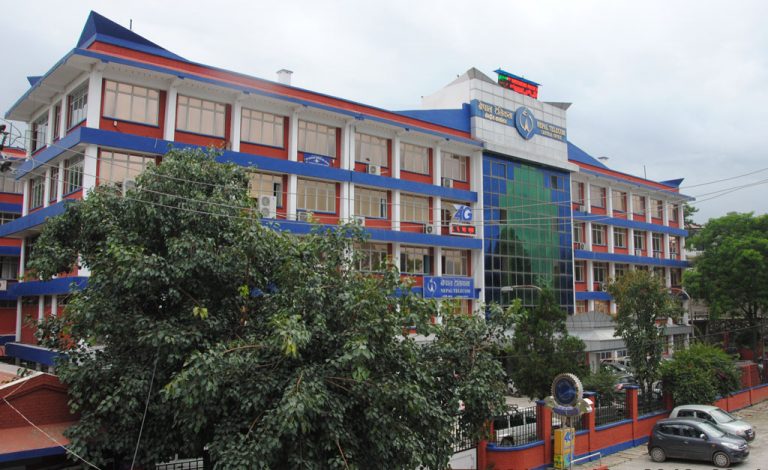
In its annual report, Nepal Telecom (NT) attributed falling revenues to high licence renewal costs, heavy taxation, and rising use of over-the-top (OTT) services like WhatsApp and Viber, which reduce traditional call and SMS revenue. NT earned Rs 38.73 billion in FY 2081/82 but posted a net profit of only Rs 2.66 billion, down from Rs 6.23 billion the previous year. The company spent nearly Rs 20 billion on GSM licence renewal alone.
The sector’s economic contribution has also shrunk. Telecom now accounts for just 1.2 percent of Nepal’s GDP and 3.4 percent of total government revenue. Private operator Ncell reported Rs 32.48 billion in revenue in FY 2024/25, of which Rs 16.98 billion (52%) went to the government through 13 different taxes and fees.
Ncell has urged policymakers to reform the draft Telecom Act, warning that without structural changes, the industry could become financially unsustainable. In FY 2023/24, telecom operators collectively earned Rs 68.5 billion but paid Rs 37.7 billion to the government in taxes and fees.
Telecom companies currently face a dense web of levies, including:
- 13% VAT
- 10% Telecom Service Charge (TSC)
- 4% Royalty
- 2% Rural Telecommunications Development Fund (RTDF)
- 2% Ownership Tax (on SIM and landline services)
- Additional advance taxes, customs duties, and social service fees.
Experts point out that Nepal’s telecom tax burden is among the highest in the Asia-Pacific region. In comparison, China charges 6% VAT and 25% corporate tax, India levies 18% GST and 25% corporate tax, while Thailand imposes 7% VAT and 20% corporate tax.
The GSMA Mobile Connectivity Index 2023 ranks Nepal 119th globally, noting that countries with lower telecom taxes tend to achieve higher investment levels, faster network expansion, and better service quality. Studies by the World Bank and the International Telecommunication Union (ITU) also show that every 10% increase in broadband penetration can boost GDP growth by 1.3%.
Industry stakeholders argue that to revive the sector, the government must eliminate sector-specific levies including the 10% telecom service charge, 2% ownership tax, 4% royalty, and 2% RTDF contribution and lower the corporate tax rate from 30% to 25%.
Nepal Telecom has also recommended revising the Rs 20 billion licence renewal fee to a performance-based model 8% of annual revenue for five years to make future investments feasible.
Without swift tax and policy reform, experts warn, Nepal’s telecom industry may soon reach a breaking point threatening both connectivity expansion and the country’s broader digital transformation goals.
Share this content:










Post Comment