Dailekh Gas Holds Multipurpose Potential; Fertilizer Plant Gets Top Priority
KATHMANDU, Nov 6
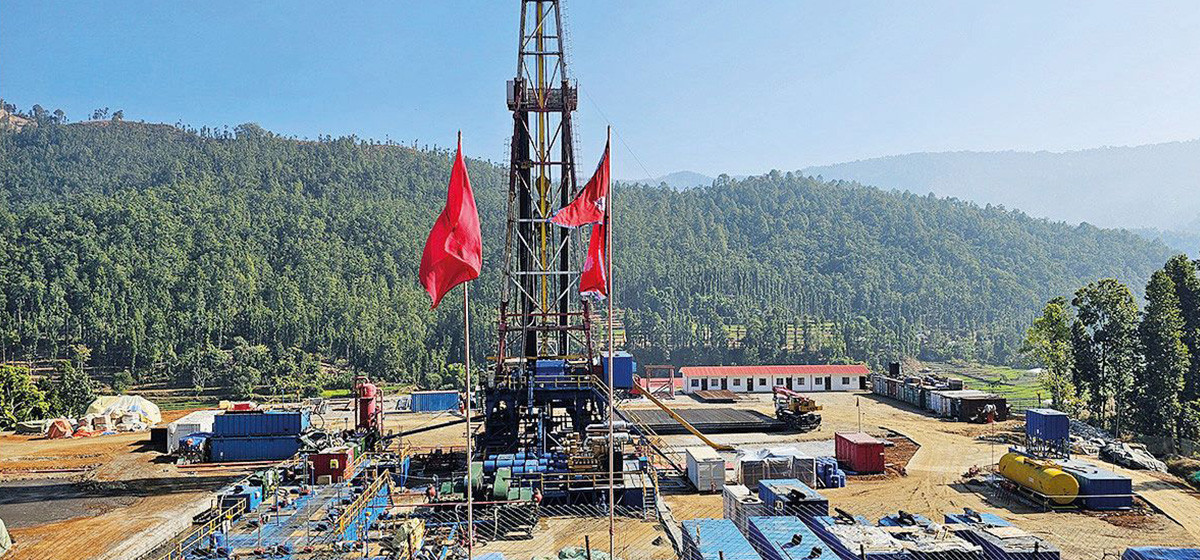
A government study has confirmed that the natural gas discovered in Dailekh can serve multiple purposes, including power generation, fertilizer production, cooking, and transportation. The findings come from a report prepared by a government task force formed to study the commercial utilization of Dailekh’s natural gas reserves.
According to Binitmani Upadhyaya, coordinator of the task force and director at the Nepal Oil Corporation (NOC), the gas discovered in Jaljale, Bhairabi Rural Municipality–1 of Dailekh district, contains significant potential for multipurpose energy use.
“The natural gas discovered in Dailekh can be utilized for several energy applications,” Upadhyaya said, adding that further investment and exploration are essential for commercial-scale operation.
Fertilizer Production as the Top Priority
The committee, formed under the Ministry of Industry, Commerce, and Supplies, has recommended prioritizing the use of Dailekh’s gas for urea fertilizer production, citing both economic and technical feasibility.
“Nepal currently has no chemical fertilizer industry,” said Upadhyaya. “Producing urea from natural gas is both viable and necessary for our agricultural economy.”
The task force has proposed establishing a fertilizer plant capable of producing around 2,200 metric tons per day, which could be expanded up to 3,500 metric tons daily for higher economic returns.
For a 2,200-metric-ton-capacity plant, the annual gas requirement is estimated at 410 to 452 million cubic meters, alongside 1,069 to 1,122 metric tons of nitrogen gas per day. The plant would need 25 to 30 megawatts of electricity, which could be supplied through a gas-based power plant built on-site.
Massive Reserve, Untapped Potential
Preliminary estimates suggest that Dailekh holds around 112 billion cubic meters of natural gas, with reserves projected to last up to 50 years, according to the Chinese exploration team that discovered the site. The Department of Mines and Geology had collaborated with the Chinese experts for the study, which involved drilling up to 4,013 meters deep.
Despite these findings, the government has yet to assign an official body to lead extraction and commercialization efforts. The NOC conducted the initial study but awaits formal authorization for future operations.
Calls for Government Action
As Nepal continues to import all its gas from India, experts and industry groups are urging the government to utilize its domestic gas reserves. The NOC’s employees’ union has also recommended that the government entrust the corporation with methane gas extraction and commercialization.
NOC Managing Director Dr. Chandika Prasad Bhatta expressed readiness to take on the responsibility:
“Since NOC already has experience in fuel trading, we are fully prepared to manage the extraction and utilization of the Dailekh gas if the government assigns us the task,” he said.
Background
The exploration of petroleum and gas in Dailekh began after the 2015 (2072 BS) Indian economic blockade, which pushed Nepal to seek alternative energy sources. Responding to Nepal’s request, a Chinese technical team began exploration in 2076 BS, eventually confirming the presence of methane gas in the region.
The task force’s latest report recommends that the government conduct detailed techno-economic studies, engineering surveys, and environmental assessments before beginning commercial production — a step seen as crucial for turning Dailekh’s gas reserves into a long-term national energy asset.
Share this content:







Post Comment